Wednesday, December 22, 2010


Wednesday, December 15, 2010
UNHCR and the Blue Key
 Here's a suggestion for an inexpensive yet valuable stocking stuffer this holiday season. UNHCR has introduced the Blue Key campaign to raise awareness of refugee issues around the globe.
You can purchase your own blue key for only $5 from the UNHCR Web site. The site also includes a downloadable book with refugees stories. Each story is followed by a response from a celebrity in the arts, politics, or elsewhere on the world stage.
Help unlock the door to a better future. Click here to learn more.
Monday, December 6, 2010
Tuesday, November 2, 2010
Dispatch from Aurora
Carina Ramos has been tutoring an Eritrean refugee since July, 2010. Here, she reflects on the experience so far.
by Carina Ramos
I will never forget the first time I ever walked into my student’s apartment, four months ago. A young, Eritrean mother of four, Gidey greeted us warmly with one of the few phrases she knew in English: “Hello, how are you?” The distinct smell of coffee beans being roasted right there in her living room struck me sharply—and not in your typical ‘Starbucks’ aromatic way, for sure…
The humble apartment was sparsely furnished and Gidey offered us two chairs at the kitchen table—and, after she rushed around trying to tidy up the apartment a bit—she sat down with us to complete the initial questionnaire. Through her eight-year-old daughter, who had already been in school for nine months and knew the most English in the house, we were able to communicate our questions to her and obtain answers.
After Sharon, the coordinator left, I stayed there longer to drink “boona”— Ethiopian coffee—with her and get to know her better. Other Eritrean neighbors and cousins came in and, since most were more fluent in English than her, acted as translators too, telling me more about her life in Eritrea as a farmer, her complete lack of formal schooling, and her excitement at the possibility of receiving English classes at her home.
I started meeting with Gidey two evenings a week, and despite frequent interruptions by her older daughter, toddler, and baby, we started scratching the surface of the English language by learning basic phrases, such as “Hello, my name is…”. Since she was completely illiterate in both Tigrinya and English, all of our classes were oral at first.
 After a couple of sessions, Gidey told me, through her daughter, that she wanted to learn the “ABC,” so we began working on saying and recognizing the alphabet visually, as well as writing it. We worked with textbooks, workbooks, notebooks, and white boards—practicing over and over again. I bought her a colorful alphabet chart, which we stuck to her kitchen wall and referred to often. It ended up being a great hit both with her, her children, and the neighbors, and was the source of everyone’s admiration. After more than two months, we started working on writing out her name, and she copied it over and over again in her notebook, trying to memorize it. I tried to put myself in her place, and imagined trying to write my name in Tigrinya, a language with strange characters, completely foreign to me. How long would it take me to recognize it when I read it, and learnt to write it?
At the end of one of these sessions, I turned over to a clean page of her notebook, and told her to write her name, without any reference to copy from. I waited anxiously to see how she would do… and watched her slowly trace the letters, one by one, perfectly! One of her Eritrean friends was sitting on the couch across the room, watching, and we all cheered and clapped as she finished writing the last letter. She smiled proudly as she examined her work. Then, she wrote it a few more times across the page, so as to cement it into her memory. What a sense of accomplishment! It was as great as writing a thousand-word essay—the feeling of crossing a hurdle initially as tall as Ras Dashen, the tallest mountain in Ethiopia. What an achievement!
In her next class, Gidey copied all of her children’s names down and practiced them in her notebook. It looked so neat and clear that I cut out the pages and stuck them on her refrigerator, while she beamed with happiness. Her handiwork was on display for her to admire every day.
 We have been moving on to food names, numbers, and other basic vocabulary—all with the goal of helping her become increasingly independent when she goes to the supermarket, to her child’s school, and to complete basic government paperwork. I look forward to helping her cross many more hurdles—though the progress may at times be slow—because her contagious enthusiasm carries us forward each session. And of course, no class is complete without a cup of home-roasted, ground, and brewed Ethiopian ‘boona’ at the end to celebrate all of our hard work.
Thursday, August 26, 2010
Noodles for a great cause!!
September 9 is the birthday of Emily Griffith Opportunity School. Here's an idea for a birthday gift that's good for you and the school. On September 9, eat at Noodles & Company's location at 6th Avenue and Broadway in Denver after 4:00 p.m.. Mention the school, and part of your purchase will be donated to the Emily Griffith Foundation. The Foundation funds student scholarships and school improvements, and many refugees have benefited from this generosity.

Save the date, and save room for a great (inexpensive) meal!!

Don't strain your eyes...Click on the picture to enlarge!
Tuesday, August 24, 2010
Currently on the NPR Website: Two stories about refugees and school--and both provide valuable insight into how a person's background affects life as a student.
New Refugee Students In NY Get Ready For US School
by The Associated Press
Photo, Associated Press/NPR
For their first fire drill, teachers at the Refugee Youth Summer Academy gathered their students, leading them out of the building to show them what to do during drills in the upcoming school year.
But one thing was missing: the sirens. They had been muted, for fear blaring alarms could trigger terror in children who recently arrived from war zones and other conflict areas where sirens can signal danger.
The silent fire drill was part of the balancing act for staff at the 6-week summer program that helps children who have survived wars and refugee camps prepare for a new experience — American public school.
It's not just about the academics, said Elizabeth Demchak, principal of the school run by the International Rescue Committee, which works with refugees and asylum-seekers.
For some of the kids, formal education has been haphazard or nonexistent, Demchak said. For others, school consisted of sitting and taking notes surrounded by dozens of others with a teacher reciting a lecture.
Preparing them means helping them learn how to go to school along with what they learn there.
To read the rest of the story, please click here.
To read or listen to the second story (listening to it gives a more authentic experience and may actually be easier to follow), please click here.
New Refugee Students In NY Get Ready For US School
by The Associated Press
Photo, Associated Press/NPR

For their first fire drill, teachers at the Refugee Youth Summer Academy gathered their students, leading them out of the building to show them what to do during drills in the upcoming school year.
But one thing was missing: the sirens. They had been muted, for fear blaring alarms could trigger terror in children who recently arrived from war zones and other conflict areas where sirens can signal danger.
The silent fire drill was part of the balancing act for staff at the 6-week summer program that helps children who have survived wars and refugee camps prepare for a new experience — American public school.
It's not just about the academics, said Elizabeth Demchak, principal of the school run by the International Rescue Committee, which works with refugees and asylum-seekers.
For some of the kids, formal education has been haphazard or nonexistent, Demchak said. For others, school consisted of sitting and taking notes surrounded by dozens of others with a teacher reciting a lecture.
Preparing them means helping them learn how to go to school along with what they learn there.
To read the rest of the story, please click here.
To read or listen to the second story (listening to it gives a more authentic experience and may actually be easier to follow), please click here.
Sunday, August 15, 2010
Refugee kids doing something good
From KUSA in Denver, a short piece about Growing Colorado Kids. This group helps refugee kids learn to raise their own vegetables, as well as sell some. Participants also learn cooking and nutrition skills. You can read more by clicking here.
Wednesday, August 4, 2010
More from the field...
Ann Lockhart is technically retired, but still works as a freelance editor. She has been a volunteer teacher in the CRESL In-home Tutoring Program since 2000.
Why I like tutoring refugees
by Ann Lockhart
Tutoring refugees has been a very satisfying and absorbing volunteer activity for me since my early retirement. Refugees really need the help to function here, not only with English, but also with daily life challenges like doctor’s appointments, deciphering junk mail, telemarketers, making appointments, filling out forms, etc.
Just as they learn the basics of the language and American culture, I always learn a lot about them, their country, culture and food. Many have stories of political discrimination, torture and displacement. Unfortunately, they can’t explain much of their past until they learn more English.
Having an ongoing personal relationship with each refugee has been really important, interesting and challenging for me. It makes me realize how very fortunate we Americans are. We think we are not rich, but we have so much more than any of them do.
After their traumatic departure from their homeland, refugees come to the U.S. exhausted, but hopeful about starting a new life in one of the richest countries of the world. Then reality sets in. They have to learn so much so fast, starting with the money, the transportation, getting a job, shopping for basics and paying back the loan for their long flight to the U.S. They also get a small apartment with mismatched furniture and very basic supplies.
A man and his wife from Sudan who later lived in Egypt were my first refugee students. He had been a self-educated magazine publisher in Khartoum, and was a political prisoner for 10 years. I was really, really nervous about meeting them, and I think they were just as nervous. But we all relaxed as in-home refugee coordinator Sharon McCreary broke the ice and introduced us. I continued meeting with them for several years, watching their children grow, learn English, attend school and gradually begin to call Denver home.
The Sudanese family was absolutely thrilled when I took them to the Denver Art Museum to see the Cezanne exhibit and again absolutely excited when I got some free tickets to take them to the Denver Symphony. I also took them to see the Glendale fireworks display July 3rd and Sunday night summer concerts at City Park.
My second assignment was tutoring a woman from Iraq with a small child, whose husband went back to Iraq as a translator to the U.S. Army during the war there. Often our English lessons were interrupted by a child’s demands, cries or interruptions. I learned a lot about Iraq and the war there.
She worked really hard to study for her citizenship test, asking me to go over and over the questions weeks before her scheduled meeting. I took her to the office for her test, which consisted of only 10 questions. To her great relief, she did very well. Attending the citizenship ceremony with many other refugees with their friends and families was a really moving experience for me.
Next was a Somali Bantu woman who left an abusive marriage, taking her baby boy with her. Little by little her traumatic life story came out. Her father was a general, and her mother a shopkeeper, but their lives all changed dramatically when warlords took over the government. Her entire extended family is scattered in various countries. She eventually went to St. Louis, Missouri, hoping to get a job and start over.
 A woman from Bhutan, whose family was forced to leave that country for neighboring Nepal, is my current assignment. Her two little girls run in and out, and family members come in and out as we try to focus on the English lessons. Her neighbor asked if she could join us, so now we three work together every week.
Preparing lessons does take some time, but I know the better I prepare, the better it goes. With the Picture dictionary, flash cards, workbooks, paper, pencils and whatever else I can come up with, we keep on working.
It’s been fun for me to share with all of them what I love about Denver and the United States. It takes time for us to communicate well about more difficult, abstract issues, going beyond pictures, gestures and simple words.
I highly recommend in-home tutoring as a very satisfying volunteer activity.
Photo courtesy of Ann Lockhart
Why I like tutoring refugees
by Ann Lockhart
Tutoring refugees has been a very satisfying and absorbing volunteer activity for me since my early retirement. Refugees really need the help to function here, not only with English, but also with daily life challenges like doctor’s appointments, deciphering junk mail, telemarketers, making appointments, filling out forms, etc.
Just as they learn the basics of the language and American culture, I always learn a lot about them, their country, culture and food. Many have stories of political discrimination, torture and displacement. Unfortunately, they can’t explain much of their past until they learn more English.
Having an ongoing personal relationship with each refugee has been really important, interesting and challenging for me. It makes me realize how very fortunate we Americans are. We think we are not rich, but we have so much more than any of them do.
After their traumatic departure from their homeland, refugees come to the U.S. exhausted, but hopeful about starting a new life in one of the richest countries of the world. Then reality sets in. They have to learn so much so fast, starting with the money, the transportation, getting a job, shopping for basics and paying back the loan for their long flight to the U.S. They also get a small apartment with mismatched furniture and very basic supplies.
A man and his wife from Sudan who later lived in Egypt were my first refugee students. He had been a self-educated magazine publisher in Khartoum, and was a political prisoner for 10 years. I was really, really nervous about meeting them, and I think they were just as nervous. But we all relaxed as in-home refugee coordinator Sharon McCreary broke the ice and introduced us. I continued meeting with them for several years, watching their children grow, learn English, attend school and gradually begin to call Denver home.
The Sudanese family was absolutely thrilled when I took them to the Denver Art Museum to see the Cezanne exhibit and again absolutely excited when I got some free tickets to take them to the Denver Symphony. I also took them to see the Glendale fireworks display July 3rd and Sunday night summer concerts at City Park.
My second assignment was tutoring a woman from Iraq with a small child, whose husband went back to Iraq as a translator to the U.S. Army during the war there. Often our English lessons were interrupted by a child’s demands, cries or interruptions. I learned a lot about Iraq and the war there.
She worked really hard to study for her citizenship test, asking me to go over and over the questions weeks before her scheduled meeting. I took her to the office for her test, which consisted of only 10 questions. To her great relief, she did very well. Attending the citizenship ceremony with many other refugees with their friends and families was a really moving experience for me.
Next was a Somali Bantu woman who left an abusive marriage, taking her baby boy with her. Little by little her traumatic life story came out. Her father was a general, and her mother a shopkeeper, but their lives all changed dramatically when warlords took over the government. Her entire extended family is scattered in various countries. She eventually went to St. Louis, Missouri, hoping to get a job and start over.
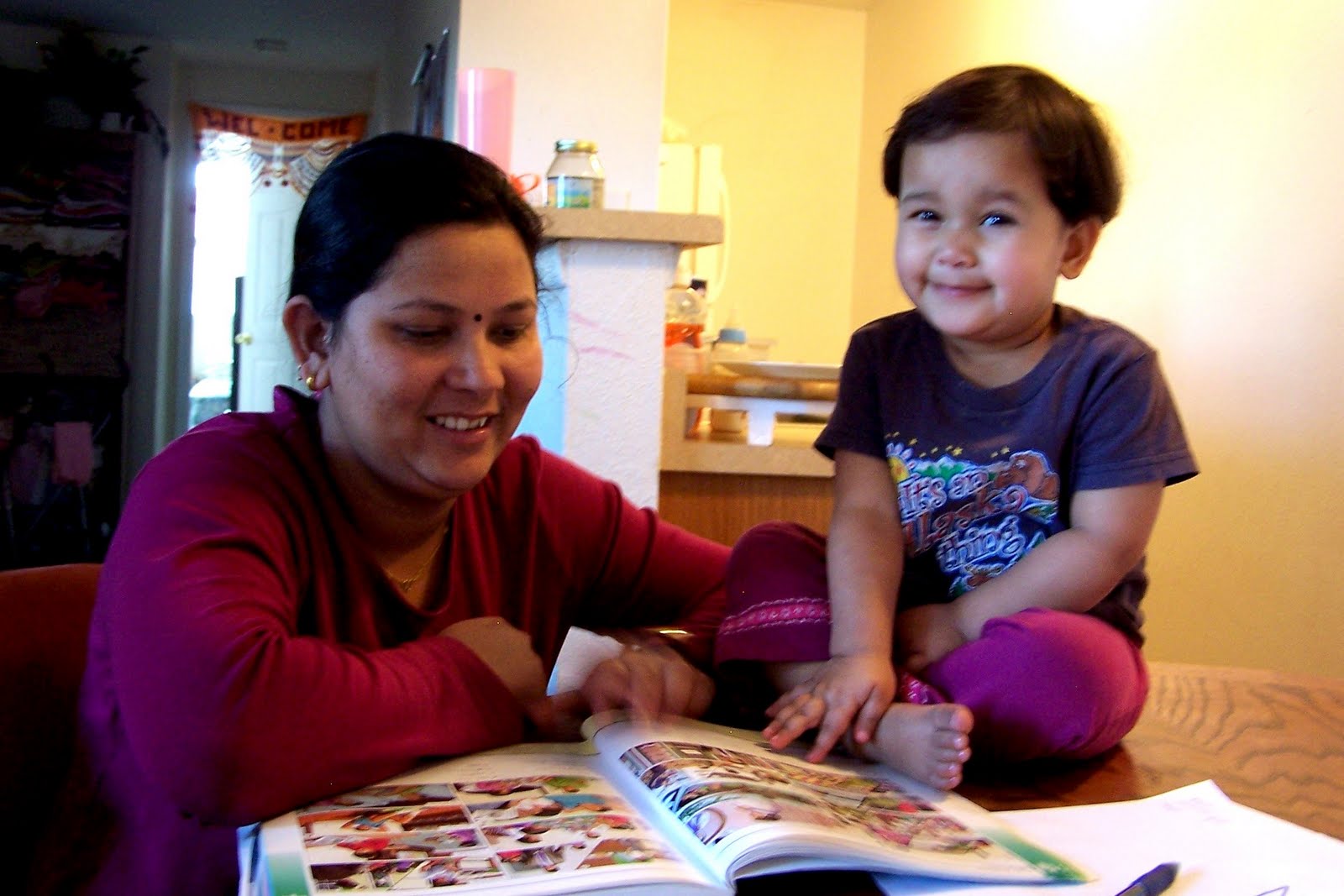 A woman from Bhutan, whose family was forced to leave that country for neighboring Nepal, is my current assignment. Her two little girls run in and out, and family members come in and out as we try to focus on the English lessons. Her neighbor asked if she could join us, so now we three work together every week.
Preparing lessons does take some time, but I know the better I prepare, the better it goes. With the Picture dictionary, flash cards, workbooks, paper, pencils and whatever else I can come up with, we keep on working.
It’s been fun for me to share with all of them what I love about Denver and the United States. It takes time for us to communicate well about more difficult, abstract issues, going beyond pictures, gestures and simple words.
I highly recommend in-home tutoring as a very satisfying volunteer activity.
Photo courtesy of Ann Lockhart
Tuesday, August 3, 2010
Employment alert
Some of you have asked about jobs in the CRESL program. There are currently several openings. Send your resume to:
Slavica Park, Dean of InstructionDo not call!!
Emily Griffith Opportunity School
1250 Welton St.
Denver, CO 80222
Monday, August 2, 2010
Time to report your hours!
It's time to report your in-home tutoring hours for JULY 2010. Please submit via email no later than this Thursday, August 5!
On Saturday, your volunteer coordinator will be heading out of town to vacation at an undisclosed location where she most definitely does not wish to spend her time working on the monthly report. (Have we ever mentioned vacations are unpaid?)
Please report your hours in a timely manner!
Sharon returns to the office on Monday, August 23, but will not be checking in during the two-week summer break. Ahhhhh.....

A visit to women's Saturday ESL class...
There are 17 photos total in this album. If it stops playing, advance manually using the buttons at the bottom of the pictures.
Friday, July 30, 2010
Parenting, field trips affected
State booster seat law changes Sunday, August 1
 On Sunday, Colorado's child passenger restraint laws will change and, going forward, all children between 4 and 8 years old must travel in the back seat of the vehicle and be in a booster seat.
For information on why the law changed, click here for an informative link from KUSA/Channel 9 in Denver.
For a full detailing of what the law requires of drivers, visit the Colorado Child Passenger Safety (CCPS) website at http://apps.coloradodot.info/carseats/
The CCPS website also includes a list of fitting stations for drivers who want to be sure they are buckling their kids in correctly. For the first year, drivers who are pulled over by the police and who are not in compliance with the child safety law will be given a warning and education only.
Please keep these rules in mind if you plan to include your student's children in a field trip!
Thursday, July 29, 2010
Highlight: Saturday women
We've recently asked volunteers in the CRESL program to tell a bit about what they do. Today's guest blogger is Elena Saenz, one of the facilitators of the Saturday morning class at Grace Apartments, and an ELA/ESL teacher in Denver Public Schools. The Saturday class started as somewhat of an experiment, and we all thought it would be temporary, but six years later, enthusiasm and participation are still strong.
 The Saturday ESL for Refugee Women class was started about 5 to 6 years ago by Susan Renick, Melissa Nix and a few other people who were looking for a solution for the women who were unable to attend Emily Griffith’s ESL classes, but who also weren't thriving in the one-to-one tutoring program. The need was for specific help for the Somali Bantu women, as those were the refugees who were also the largest group at that time.
The class has since evolved to serve whichever groups of refugee women are currently living at Grace Apartments or in the surrounding community. At present, the women attending the class include the Burmese Karen and Karenni, Somali Bantu, as well as women from Burundi and Bhutan. We have learned to remain flexible since this makeup changes from year to year.
I got involved about four years ago. I was working with these women’s children as their ESL teacher at Whiteman Elementary in Denver and wanted to expand my knowledge of their culture and home life. Since then, I have become one of two lead “teachers.” Melissa Nix (Regis University) and I (Denver Public Schools) share the responsibilities along with a myriad of volunteers.
 This is a free program and everyone who helps is a volunteer. Melissa and I make sure the community room at Grace is open every Saturday and that fresh fruit and vegetables are provided for the students (Melissa writes a grant that underwrites this expense, plus provides occasional materials). We don’t use a specific curriculum with the women as we never know who is going to come. We attempt to guide ourselves by the needs of the women and their individual English levels.
We meet most Saturdays. We start between 8:15 and 8:30 a.m. Most of the women arrive no later than 8:45. We break up into two major groups (beginner and intermediate/advanced). Volunteers work with a group, partners, or an individual. We have materials available, plus some volunteers bring their own things to work from. We work until about 9:45 and then stop to make sure that we can pass out fruit and veggies and put the room back in order before leaving.
The women are so appreciative of the time to practice or better their English, as well as for the food. The wonderful reception and gratitude by the students are two of the reasons why I have continued to work with them for so many years. For me, there is nothing more special in this world than spending time with a group of women who give more to me than I will ever be able to give to them.
Elena Saenz
Saturday ESL volunteer
If you would like to join the Saturday volunteers at Grace, please contact sharon_mccreary@dpsk12.org.
Monday, July 26, 2010
More online resources
 If you're looking for more ideas on how to approach language teaching, there are hundreds of resources available on the Internet. Today's link is for English with Jennifer, A site for language learners.
Jennifer is a language teacher who has both studied and worked abroad. She has created a series of self-study lessons for students, as well as some tips for teachers. Video lessons are available via YouTube. Also take a look at the Everyday Vocabulary section of the site.
Jennifer has a companion blog just for teachers. The blog is full of great advice, teaching tips, and lesson ideas. Be sure to take a look at her lists of useful links and resources. The site is well-written and easy to access.
If you prefer to stick with video and you are looking for videos to incorporate into your lessons, Jennifer has an entire YouTube channel that you can access for free. Click here to see the wealth of videos Jennifer has created.
Friday, July 23, 2010
More is better
 A couple of years ago, I shared a video that was making its way around the Internet. It was created by world traveler Matt Harding of Seattle. It remains, without question, one of my favorite things. I have it saved to the hard drive of my computer, and I still watch it on those days when I need a lift.
Somehow, I managed to miss that Harding had participated in something else I hold dear: The "This I Believe" essay series on National Public Radio.
I like Harding's essay. I think he articulates what a lot of us feel about being an explorer, a traveler, and a tribe member. He understands that we want to connect. If you didn't agree, you probably wouldn't be volunteering in a program like this one.
Click here for the link to the NPR story, but do yourself a favor: Listen to it, don't read it. It's meant to be an audio piece. You can also find a link to Matt's video on this page, as well. On the NPR page, click the picture that matches this one, above.
Monday, July 19, 2010
Employment leads
 It's a fact that many people who volunteer with our programs also hope to eventually become employed in a related field. I field many inquiries about job openings, but that's hard to keep up with when so many volunteers are in the mix.
At the moment, quite a few new positions have been posted throughout the network. If you are interested in a teaching position or if you are more inclined to do case management or agency work, there's a chance there's something available now. Polish those resumes and check these Websites:
Lutheran Refugee Services (at least two positions open) http://www.lfsco.org/about_employment.php
At Ecumenical Refugee Services, there is currently an opening for an employment specialist assisting refugees with job placement. Contact Sabina Durmisi at sabina@ersden.org
African Community Center, http://www.acc-den.org/jobopeningsnew.htm
The Learning Source: http://www.coloradoliteracy.org/index.cfm?fuseaction=page.display&page_id=29
Emily Griffith Opportunity School, Language Learning Department and CRESL Program: Click here to go the DPS search page. In the second box, "Search words or phrases," type EMILY and then click the search button. This will show you all open positions at the school.
Spring Institute: Check out their jobs page: http://www.spring-institute.org/?action=opportunities
Happy job hunting!
Monday, July 12, 2010
Film screening
National Geographic’s documentary,
“Inside North Korea”
featuring Lisa Ling
Tuesday, July 13 at 7pm
African Community Center
850 Holly St, Denver CO
 National Geographic correspondent Lisa Ling journeys into mysterious and reclusive North Korea posing as part of an international medical team in this compelling documentary. Filmed against the politically charged backdrop of North Korea's nuclear ambitions, "Inside North Korea" is a fascinating search for the truth, and mutual understanding, inside one of the most isolated and repressed nations on Earth.
This event is brought to you by LiNK, (Liberty in North Korea) an organization currently working on a modern day underground-railroad, helping refugees who have escaped North Korea. By North Korean law it is illegal to leave the country; however, many North Koreans face starvation and complete religious oppression and persecution if they stay. Those who risk their lives to flee to China must live in hiding. If caught, they will be sent back to North Korea and executed or put into a concentration camp.
Learn more on the LiNK Website, http://www.linkglobal.org/.
Friday, July 9, 2010
Call for Volunteers
Help organize a speaking event featuring
Valentino Achak Deng
 Valentino Achak Deng is a Sudanese refugee and the subject of the bestelling book, What is the What by Dave Eggars. Since the publication of the book, he and Eggars have established the The Valentino Achak Deng Foundation, a US-based nonprofit organization working to increase access to education in post-conflict Southern Sudan by building schools, libraries, teacher-training institutes, and community centers.
In May of 2009, the foundation opened The Marial Bai Secondary School in Marial Bai, Valentino’s hometown. To learn more about the foundation, you can see their website at http://www.valentinoachakdeng.org/.
Valentino will be in Boulder from September 11 to September 13. Sara Beth Ford, who has worked with refugees extensively, along with several others, is putting together a group to set up a speaking event in the Boulder-Denver area. Sara's group needs the assistance of dedicated volunteers who are interested in helping with this project. This is a wonderful opportunity to be involved in raising money for the foundation and educating people about the lives of Sudanese refugees.
If you are interested in being a part of this project, Sarah would love to hear from you. Please contact her ASAP with your name and phone numbr. Include a brief note telling how you would be interested in helping out. A preliminary planning meeting is planned for Tuesday, July 13 or Wednesday, July 14 at 6:30 p.m. in Lousiville.
This is a rare opportunity to work on a short-term project that will raise awareness of refugee issues both here and abroad.
You can contact Sara by email at sara@ersden.org.

In April of this year, New York Times journalist Nicholas Kristof wrote an excellent Op-Ed piece about Valentino Achak Deng's work in Sudan. You can access the article by clicking here.
Tuesday, July 6, 2010
For those who want some online practice
 If you haven't found it already, I highly recommend a self-study ESL site called U.S.A. Learns.
According to the site creators:
U.S.A. Learns is an outgrowth of a project that was conceived by the U.S. Department of Education (ED), Office of Vocational and Adult Education, Division of Adult Education and Literacy (DAEL). DAEL promotes programs that help American adults get the basic skills they need to be productive workers, family members, and citizens. The major areas of support are Adult Basic Education, Adult Secondary Education, and English Language Acquisition. These programs emphasize basic skills such as reading, writing, math, English language competency and problem-solving.The lessons are lively, interactive, and self-paced. Please visit the "About us" page to learn a bit about how the site is structured and what it has to offer both the teacher and the student, then tour the video introduction. I recommend that tutors go through the course to get lesson and curriculum ideas, as well as to see how you can assign homework to your student. Take some time to explore and get to know the site--there is a lot available in this rich resource.
 The site offers multiple levels of English lessons, videos, listening, reading, and writing modules, and tests.
Help your student register and set up an account--this allows her (or him) to save and resume lessons and keep a cumulative record of test scores.
This is an excellent free resource. Many of our in-home students have computers for their school-aged chuildren but may not understand what need they have for them themselves. Others, particularly the Iraqis, are computer literate but don't know where to go for extra English practice.
Check it out and enjoy!
Friday, July 2, 2010
Fourth of July fun and fretting
Just a reminder that the sounds of July 4th weekend can be frightening to a survivor of armed conflict. Please read my earlier post about this by clicking here.


Wishing you all a safe and happy
Independence Day weekend!
Independence Day weekend!
Subscribe to:
Posts (Atom)